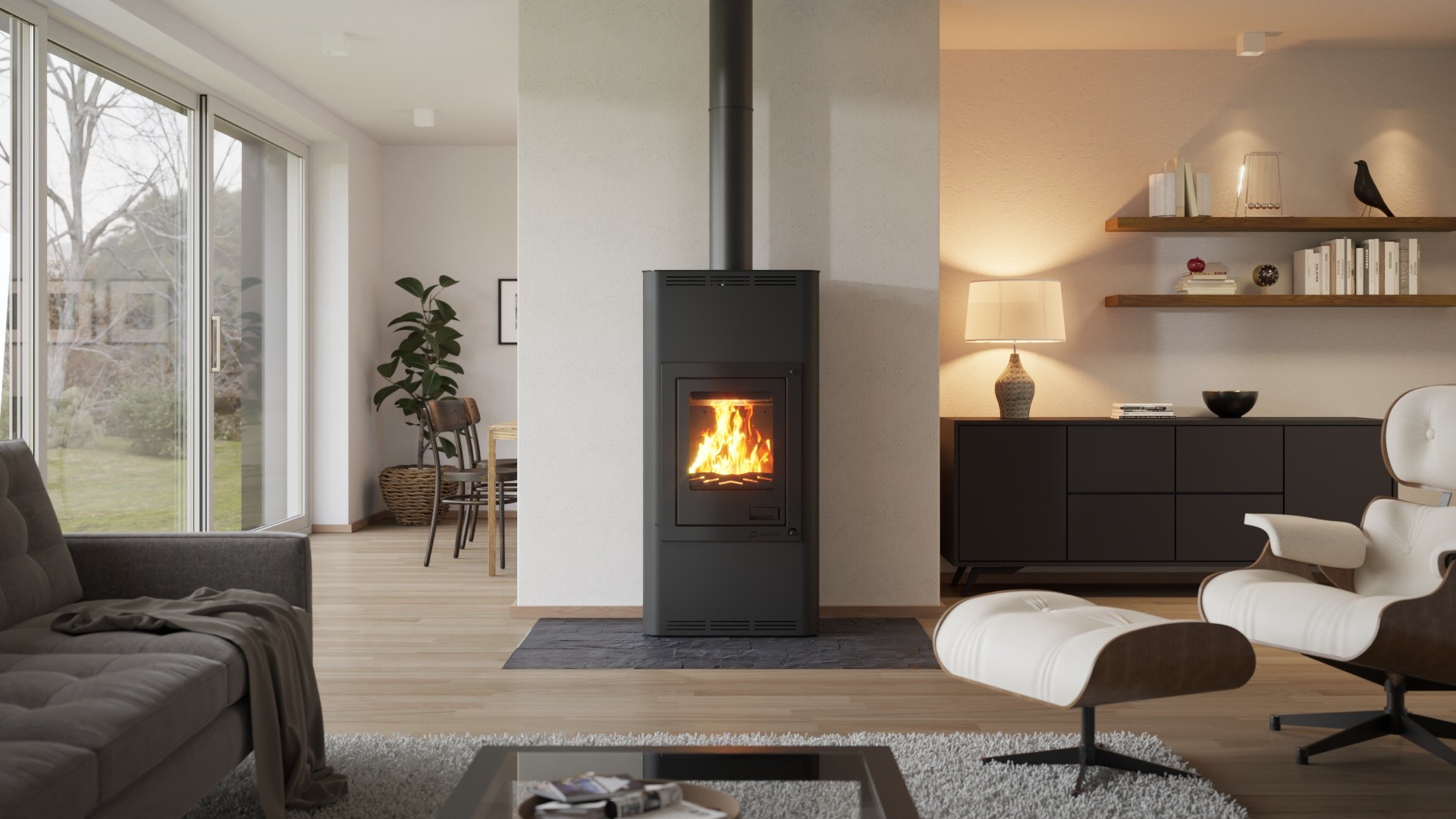
When determining the required output, it is always best to consult professionals who will calculate the exact output based on heat loss and other factors. Selecting the correct output is the most important step when choosing a fireplace insert or stove, and we strongly recommend not underestimating it. As a rough guide only, you can estimate that 1 m³ requires 50 W in a poorly insulated house, 25 W in a well-insulated new build, and 80 W in recreational properties (cottages, etc.).
An external air supply is recommended primarily in new builds, so-called passive or eco-houses. For proper combustion, stoves need an adequate air supply, and in modern, well-sealed buildings it can happen that the stove draws air from the interior until the air "runs out." The stove then does not burn as it should, and breathing inside the building becomes more difficult.
A further issue can arise with extractor hoods, which in some cases may "overpower" the chimney draught, causing the stove to smoke into the room.
In older and less well-sealed buildings, air recuperation through gaps around windows, doors, etc. is substantial enough that the stove always has a sufficient air supply without needing to bring air in from elsewhere.
With manual control, you operate the air inlet damper using a lever (push/pull). With basic/electronic control, you also operate the air inlet damper manually, but via a potentiometer on the front of the stove (left/right). The movement of the potentiometer is then translated into the damper position through a servo motor. In addition, the basic/electronic control uses a temperature sensor to monitor the water temperature in the heat exchanger and, if the temperature rises too high, automatically closes the air inlet damper and alerts you to overheating with an acoustic signal.
Of course – as the manufacturer, we have all spare parts for our products in stock. You can enquire about any spare part by emailing info@hsflamingo.cz.
Our stoves are designed exclusively for burning wood and wood briquettes. Using coal or brown-coal briquettes may void your warranty and, in the worst case, permanently damage the stove through overheating.
It always depends on the circumstances — primarily the quantity and type of fuel, as well as the amount of air supplied and the chimney draught. When using hardwood with a partially closed air inlet, the stove can burn for up to 8 hours.
If the stove smokes into the room, the problem is usually insufficient chimney draught. When the draught is too weak, it is unable to draw out the accumulated flue gases from the combustion chamber. Another issue may be incorrect reloading technique. According to the manual, fuel should only be added when the existing fuel is no longer burning with a strong flame, and the door must always be opened just slightly first to equalise the pressure before you reload.
All our stoves and fireplace inserts require a minimum chimney draught of 12 Pa for correct operation. A chimney sweep can measure the draught with the stove connected.
The problem is most commonly caused by insufficiently dried fuel. Fuel should never contain more than 20% moisture. The issue may also be caused by insufficient chimney draught, which cannot draw in enough air for the airwash system to function correctly. Another possible cause is worn door and glass seals, which over time become compressed and allow the stove to draw air through the door.
Our wood-burning stoves and fireplace inserts are on display at our trade partners' showrooms throughout the Czech Republic. You can find a list of our partners in the DEALERS section. You are also welcome to view our products at our company showroom in Broumov — open every weekday from 8:00 to 16:30.
When purchasing a stove that does not have a chimney damper built into its construction, we always recommend including this component in the flue pipe. The damper helps you regulate the chimney draught more effectively, and thereby the combustion in the stove or insert. Another option is a chimney draught regulator, which automatically maintains the draught at a set value. Draught regulators work on a very simple principle and are affordably priced.
All our products with a water heat exchanger include a cooling loop as standard.
To connect the cooling loop, you need a mains cold-water supply to the stove/insert and, where applicable, a drain connection. You will also need to purchase a thermostatic safety valve, which admits cold water into the loop based on the measured temperature in the heat exchanger.
Reducing the flue outlet diameter of a stove or insert is generally not recommended, as it can result in a drastic reduction in chimney draught and consequently insufficient draught for the correct functioning of the appliance. In some cases, however, such a reduction may be possible, but only after consultation with a professional (chimney sweep/heating engineer).
Sealing ropes are replaced depending on their condition. Some sealing ropes are routinely changed every heating season, while others may last up to five years. It is important to check that the sealing rope is actually sealing properly — you can do this, for example, by taking a sheet of paper and trying to close it in the door. If the rope is working as it should, the paper cannot be pulled out, as it will be held firmly between the rope and the stove body.
To replace the sealing rope, remove the old seal, clean off any remaining adhesive, sealant or dirt, degrease thoroughly, apply new adhesive and press the new sealing rope into the groove, then allow the adhesive to cure in accordance with the manufacturer's instructions.
It is strictly prohibited to operate inserts and stoves fitted with a water heat exchanger when the heat exchanger is not filled with water. Doing so could result in loss of warranty and, in the worst case, irreparable damage to the appliance and personal injury.